Stuck in Line

Hi friends,
What a day! GDP came in lower than expected, the Fed’s preferred price measure came in far above their desired target, and the Supreme Court says Trump doesn’t have the right to impose emergency tariffs. Now, don’t think tariffs are going away anytime soon—the President, his NEC Director, Kevin Hassett, and his Treasury Secretary, Scott Bessant, have been making it clear that they will use other authorities to impose tariffs as the President said in his press conference. But questions remain: does the Treasury have to pay back the tariffs that have been paid? What happens to the deficit?
These questions will take time to parse and we’ll come back to them. In the meantime, let’s talk about energy!
Read on—just one chart and less than 780 words.
Chart of the Week: Energy demand has soared and the wait in the interconnection queue keeps getting longer. In 2008, a new project typically had to wait less than two years to get connected. But by 2024, it was over 4.5 years.
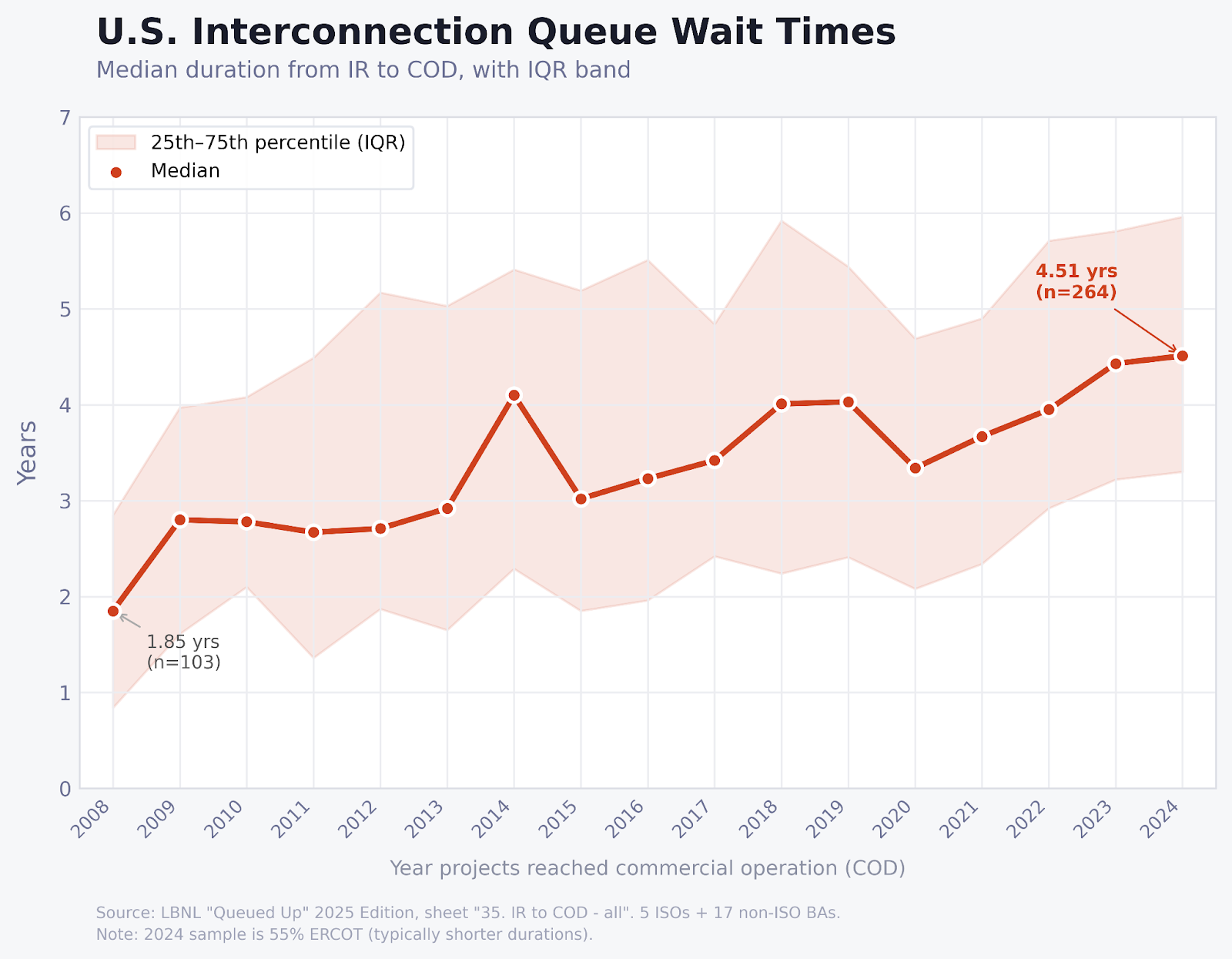
Waiting on the line
What’s the queue? Before any electricity-generating project can deliver a single electron to families and businesses across the country, the project developer must submit a request to regional transmission organizations to join what folks call the interconnection queue. Then, they enter a long line with lengthy processes that evaluate the project’s environmental impact and what upgrades the grid needs.
In the three years following the passage of The Inflation Reduction Act, companies announced over $843 billion in investments in clean energy projects. Needless to say, a fast queue is crucial to growth. (We’ll dig into tracking those investments in a future newsletter!)
This has become one of the biggest bottlenecks in building a clean energy economy. Of the new electricity generation waiting in the queue, almost all (94%!) are renewable.
To make matters worse, the grid infrastructure is outdated and now overwhelmed as data centers and AI models try to get enough juice—both issues I’ve covered in past weeks.
Stay in line? The amount of energy waiting to join U.S. electricity grids has hit a whopping 2,300 gigawatts—or 175% of all installed power generation on the U.S. grid. The electrons waiting could power 2,300 cities the size of San Francisco at peak demand.
The energy impact: An inconvenient queue creates incentives for companies to build natural gas turbines “behind-the-meter”—that is, connect directly to a natural gas generator, avoiding the grid entirely. Connection to behind-the-meter gas takes about 18-24 months, and a data center build timeline is 18-36 months.
Because this is the fastest route, the U.S. electricity grid is facing “fossil lock-in,” remaining dependent on outdated infrastructure and industries—and pumping carbon emissions into the environment.
What can be done? In 2023, the Federal Energy Regulatory Commission issued a rule that shifted to a “first-ready, first-serve” queue, reviewing projects in batches and imposing stricter readiness requirements to move the line along. Think of this like when the restaurant maitre’d won’t seat you until your whole party has arrived.
The order also looked to combat phantom requests, where developers submit speculative queue requests to multiple operators in hopes of getting connected.
Grid operators are raising deposits and financial requirements to deal with speculative projects. In 2022, PJM began requiring study deposits of up to $400,000, additional deposits at each stage, a nonrefundable entry fee, and withdrawal penalties.
Keeping with our restaurant queue, this and above are akin to a reservation charge to limit no shows and double bookings.
State-level solutions
Oregon: As of 2024, planned projects in gigawatts in Oregon reached triple digits. To streamline and speed up the queue, the Oregon Public Utilities Commission updated its process to more precisely review projects based on their potential impact on the grid. They also implemented timelines for smart inverters, replacing imprecise screens that over-flagged projects.
California: Last year, the California ISO—a nonprofit organization that manages the flow of electricity across power lines, operates a wholesale energy market, and oversees transmission planning—launched the 2025 Interconnection Prioritization Process. The initiative is aimed at speeding up the queue for projects whose plans show readiness and alignment with the state’s clean energy and decarbonization goals.
Illinois: Commonwealth Edison (ComEd) and Ameren are the two largest utility companies in Illinois, covering more than 70% of the state’s population. ComEd concurrently reviews several projects in the queue and performs hundreds of studies monthly. In response to President Trump’s Big Beautiful Bill (which rolls back federal tax credits for solar), Ameren plans to implement a revised review process by 2027 to speed up the 1,700+ projects in its queue.
The interconnection queue is at the core of getting clean power to the grid to replace dirty power. If we want more clean energy getting to our homes and businesses, we need to get the line moving faster.
More Like This: I recently joined the Kleinman Center for Energy Policy at the University of Pennsylvania. If you are enjoying this newsletter, I encourage you to sign up for the Kleinman Center newsletter, where you’ll find an array of energy policy related research and writing from me and my new, amazing Penn colleagues.
Best,
Heather