Twiddling While Rome Burns

Hi friends,
I’ll admit that I’m getting nervous. Between the President’s war of choice in Iran, which is creating threats to the global economy, and this morning’s job report, the risks to the U.S. economy are mounting. On top of these immediate economic concerns, a recent article about how rich some of Wyoming has become (the average annual income of the top 1% in Teton County is $35 million while the median state per-capita income is $55,000) underscores a longstanding economic weakness documented twenty-two years ago in one of the most important economic papers of the century. In the Quarterly Journal of Economics, Thomas Piketty, Emmanuel Saez, and Gabriel Zucman laid out how the incomes of the top 1, 0.1, and .01% had pulled away from the rest of America. During the Biden years, one of our explicit goals was to reverse these trends. We made some progress, but with President Trump doubling down on taking from the majority to give to the top, the work remains in front of us.
Read on—just one chart and 759 words.
Chart of the Week: From 1979 to 2021, average income of the top 0.01% grew 27 times faster than the bottom 20%. In 2021, the richest 1% earned 139 times as much income as the bottom 20%.
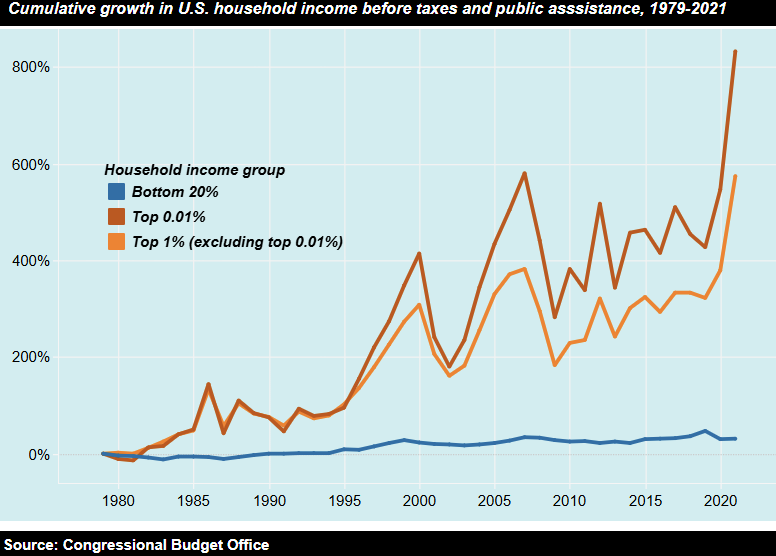
How Far from the Top?
As Thomas Piketty taught us in his bestseller Capital in the Twenty-First Century, income inequality calcifies into wealth inequality. Since the Federal Reserve started tracking household wealth, the gap has widened. As of 2025, the top 1% of households hold over 30% of the nation’s wealth, while the bottom 50% hold 2.5%.
Tax cuts for the top and service cuts for the rest exacerbate these trends. Since President Trump’s 2017 tax cuts, the number of U.S. billionaires has increased 50%. By 2034, the Big Beautiful Bill will raise the incomes of the top 10% of earners by over 2.5%, while the lowest 10% will see their incomes fall by over 3%.
The millionaires and billionaires (and soon trillionaires) are using vast wealth to reshape our democracy. Billionaire election spending increased from less than 1% of political spending in 2000 to over 16% in 2024.
High inequality has become a cover for corruption. Since the start of President Trump’s second term, his family has made billion-dollar deals in cryptocurrency, advanced technologies, real estate—and made an estimated $4 billion.
We need more than good academic studies. We need an economic agenda that contains the top and provides counterweights to concentrated economic power. The basics:
Raise taxes at the top (including taxing wealth)
Combat market concentration and ensure that everyone plays by rules that benefit us all
Improve access to affordable and high-quality healthcare and childcare
Ensure that every worker has the right to join a union and earn a fair day’s pay
Raise the minimum wage; 14 million workers earn less than $15/hour
What won’t address the affordability crisis and structural inequality? Costly wars of choice.
President Trump’s attack last year in Yemen cost American taxpayers between $2.76 billion and $4.95 billion, while Operation Midnight Hammer cost over $2 billion.
Iran controls the Strait of Hormuz—a fifth of the world’s oil supply. While economic security grows increasingly out of reach for most, we can expect higher gas prices.
This morning, we saw that in February, employment declined by 92,000, while the unemployment rate increased to 4.4%. Employment numbers for both January and December were revised down.
In 2025, the labor market was propped up almost entirely by health care jobs (713k out of 733k). Last month, health care employment fell by 19,000. While strikes in California placed downward pressure on the sector, after Trump-led legislation gutted funding for hospitals and left millions uninsured, we should be wary of thinking that health care jobs can pull the labor market out of an economic downturn.
Despite ongoing claims from the Administration about a revival of American manufacturing, the sector lost another 12,000 jobs in February.
Gaps on the Ground
California: Compared to households in the 20th percentile of wealth distribution, those in the 80th percentile have a net worth 100 times higher. Despite the state median annual household net worth being over $100,000 higher than the national median, over 2.4 million residents are behind on utility bills and 1.8 million children lack access to affordable childcare. To combat the gap, lawmakers have proposed the 2026 Billionaire Act, a one-time, 5% tax on the net worth of 200 billionaires, estimated to generate $100 billion.
Washington: Starting in 2022, Washington began taxing 7% on capital gains up to $1 million and 9.9% on gains exceeding $1 million. Introduced in February, SB 6346—the “Millionaire Tax” that imposes a 9.9% tax on personal income in Washington above $1 million—has passed the Senate. If the legislation becomes law, it will affect 0.5% of households and raise $3.5 billion.
New York: The Gini coefficient, a measure of income inequality ranging from zero to one as lowest to highest, is over 0.5 in New York—the highest of any state in the country. From 2019-2024, wages in the top 3% grew over four times faster than wages in the bottom 20%. In Manhattan, the average rent for a one-bed apartment is over $5,100, and over 80% of families cannot afford childcare.
There’s lots we need to do to save our democracy, but one thing is certain: We cannot fix what ails us unless we contain and reverse the rise of the 1%. There are lots of good, pragmatic ideas out there. Let’s do this.
Best,
Heather