Heating Up Economic Thinking

Hi friends,
Workers are on track for a dangerously hot summer, but the rules we need to protect them aren’t up to the task. Hotter temperatures, whether gradual or sudden, have a negative effect on workers across a variety of industries—outdoors and indoors—that have a downward pull on productivity. The early months of 2026 have been the hottest on record and capped the warmest 12-month period ever recorded. To talk about what protections workers need, David Michaels and R. Jinsung Park joined me to discuss what rising heat means for people, places, and our economy. Read on for some of the things that stuck with me from this informative conversation.
Read on—just one chart and 750 words.
Chart of the Week: As temperatures progressively increase, the number of recorded injuries—which often don’t account for all the injuries that happen—has increased. From 1999 to 2023, the number of heat-related deaths in the United States increased 117%, with 2023 being the highest and 2022 being the second highest.
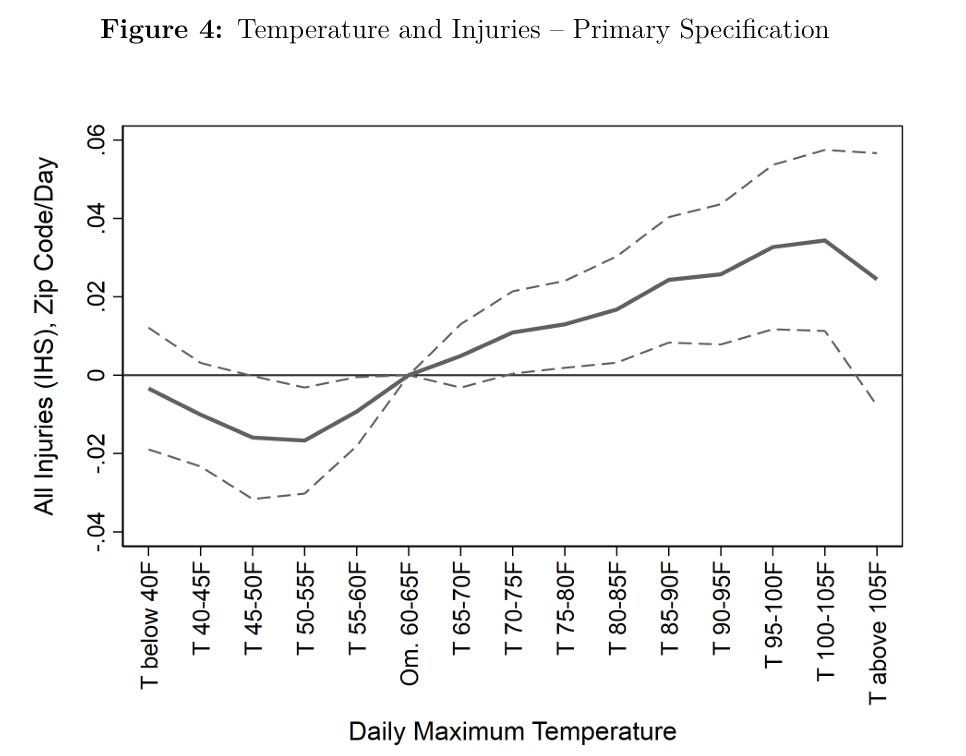
Temperatures up, productivity down
High heat obstructs productivity. Higher productivity increases a worker’s value to their employer and can improve bargaining power—the ability to negotiate working conditions, benefits, and wages.
Across certain labor-intensive manufacturing industries, for every degree over 80° Fahrenheit, productivity drops an estimated 4%. For indoor workers, as temperatures exceed 77° Fahrenheit, productivity drops an estimated 5-7%. For the 2.4 billion workers worldwide exposed to heat stress, productivity can drop up to 3% for each degree above 68° Fahrenheit.
Around one-in-five Americans in the workforce works outdoors. Between now and 2065, U.S. workers’ exposure to heat is expected to quadruple.
The productivity drag from high heat is another reason why ignoring the threat of climate change will continue to constrain economic growth.
2024 was the hottest year on record, capping the hottest decade on record. Globally, from 2000 to 2023, the number of workdays exposed to excessive heat during heatwaves increased by 23%.
Since 1960, the average U.S. heat wave season in a city has increased by 46 days, while the average heat wave in a U.S. urban area now lasts four days.
All ten years with the most amount of acreage burned due to U.S. wildfires have been since 2004.
By 2030, excess heat and resulting compromised work capacity is expected to cost the global economy $2.4 trillion. In the United States, economic losses due to heat have surged 70% from 2001 to 2023.
From 2001-2023, heat-related productivity losses cost the construction industry $38 billion, while smaller, rural counties lost 3% of their GDP.
Technology, climate, and other external factors will alter the composition of the workforce. We can adapt to protect workers (joining other economies and competitors) or live with the new downward pull on U.S. productivity.
Last month, President Biden’s Occupational Safety and Health Administration’s Heat National Emphasis Program, which outlined heat-related protections for an estimated 36 million workers, expired. It was then revised and replaced by the Trump administration—though there’s still no finalized federal heat standard rule.
The National Institute for Occupational Safety and Health is tasked with researching and recommending health and safety measures. In April 2025, President Trump fired 85% of the NIOSH workforce.
In February, President Trump nominated David Keeling to lead the agency, a former safety executive of Amazon and UPS. Under his leadership, the two companies racked up 300 workplace safety violations and $2 million in OSHA citations.
If the federal OSHA issues no heat standard, states with their own OSHA programs (like California) can pass their own rules. However, only 22 states have their own OSHA programs. Only seven states—ranging from Nevada to Minnesota—have heat-protection standards for workers.
Heat protections on the ground
California: In 2024, California approved new workplace rules to protect indoor workers from extreme heat. The rule establishes temperature thresholds and requires cooling areas and adjusted schedules and equipment. Prompted by streaks of triple-digit temperatures and surges of wildfires spanning thousands of acres, the heat protection applies to an estimated 1.4 million and aims to reduce heat injuries in the workplace by 40% by 2030.
Nevada: Between 2016 to 2021, annual heat-related complaints averaged around 133; through just nine months of 2024, 467 complaints were filed. In the summer of 2024, Las Vegas faced 74 days of temperatures exceeding 100° Fahrenheit, while Reno faced four 105° days in a row. As of April 2025, under Nevada’s OSHA, any employer with more than ten employees (and explosive manufacturers of any size) must conduct job hazard analyses and provide protective measures and employee training.
Texas: 24% of the Texas’ total workforce are outdoor workers. In 2023, House Bill 2127 preempted local municipal ordinances that “mandated water and rest breaks for construction workers,” but the state remained under federal OSHA’s General Duty Clause. The rollback of local ordinances was ruled unconstitutional in a lower court but remains unresolved; by midcentury, Texas outdoor workers are estimated to lose 27 workdays due to extreme heat and $12.2 billion in total annual earnings.
It’s getting hot out here. It’s an empirical truth that minimizing emissions and keeping global temperatures from continuing to rise will make it possible for workers to keep doing their jobs well.
Best,
Heather
This is an interesting lesson on how climate science impacts economics. The science-denying MAGA/Republican regime typically ignores or attacks sound reasoning like this. At first glance this seems like blind ignorance. It's shocking. It stupefies us. (I think shocking and stupefying mean the same thing as “gobsmacking” which is a more popular word now. They describe "something so incredibly astonishing or overwhelming that it leaves you temporarily unable to think clearly, react, or process your surroundings.”) After being gobsmacked, it takes me some time to recall that authoritarians always need a monopoly on truth. Experts on totalitarianism show us that the regime seeks to train us that it is the only source of truth. It can’t tolerate sources like science and reason because they are methods for finding the truth that are independent of it and don't need the regime's permission. I’m finding out it takes self discipline to remember that their science denial isn’t ignorant or stupid. It’s crafty and intentional.